Differences between induction and glass ceramic hobs - do you know them all?
Choosing a cooktop is one of the most important decisions when furnishing a kitchen. Two modern types dominate the market: induction hobs and glass-ceramic hobs. Both technologies offer an elegant and easy-to-maintain solution, but their principle of operation, efficiency and user experience are fundamentally different.
The goal of this guide is to dispel the main dilemma of choice and provide you with a complete encyclopedia to make your decision easier. From the principles of operation, through a detailed comparison of parameters, to specific recommendations and maintenance tips.
Curiosity that draws you in: The induction hob can bring water to a boil up to 50% faster and with up to 20% lower energy consumption than its glass-ceramic counterpart, making it the fastest and most energy-efficient cooking technology, after direct gas.
Principles of operation: Induction vs. Glass ceramics
The fundamental difference between the two types lies in the way they generate and transfer heat to the dishes.
How an induction hob works
The induction plate uses the phenomenon of electromagnetic induction. Under the glass-ceramic plate is a copper coil through which an alternating current passes. It creates a rapidly changing magnetic field.
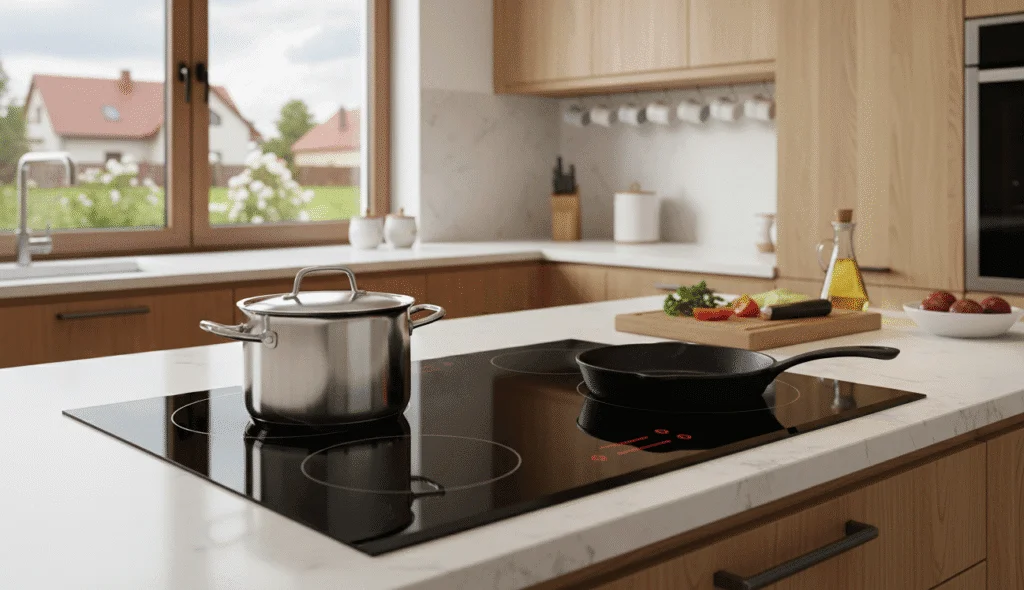
Principle: As soon as you place dishes with a ferromagnetic (conductive) bottom on the plate, the magnetic field induces so-called eddy currents in it. These currents hit the resistance of the material, generating heat directly inside the bottom of the container. Construction: Heat is generated in the cookware, not in the plate itself. The glass-ceramic surface is heated only secondarily by the hot pot. This ensures high energy efficiency (up to 90%) and safety. Cookware Requirements: Crockery with a magnetic bottom is essential. A simple test is to apply a magnet - if it holds, the dishes are suitable.
How does a ceramic hob work?
The glass-ceramic plate works on the principle of radiant heat, similar to traditional cast-iron hotplates, but with a much more efficient transfer through the glass-ceramic plate.
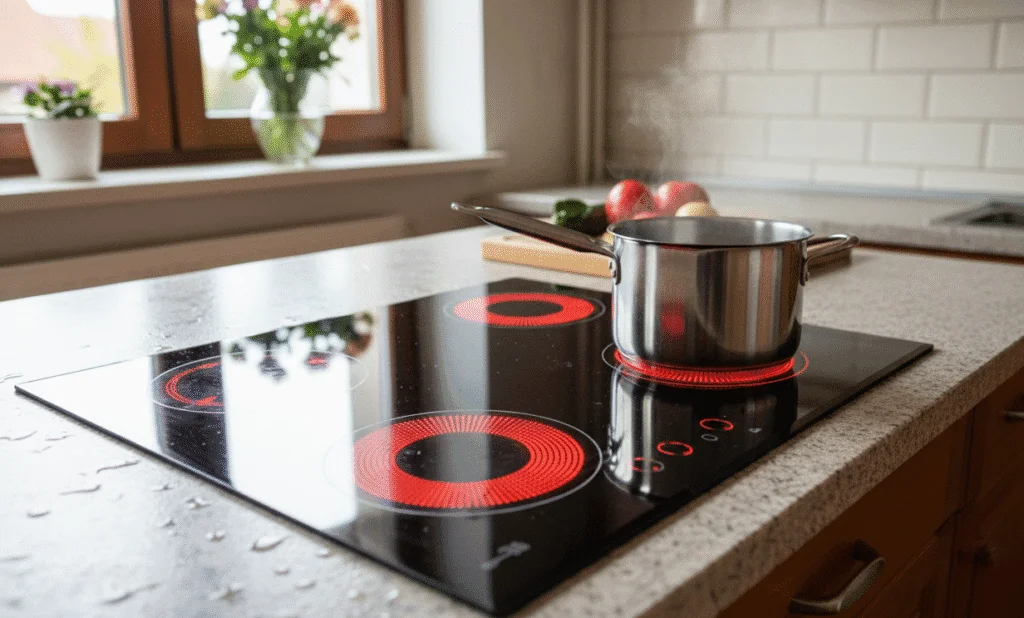
Principle: Under the glass-ceramic surface are placed resistance (heating) coils or halogen bodies. These become hot after switching on and the heat is transferred by radiation and conduction through the glass directly to the bottom of the dishes. Construction: The heating element is heated first, then the glass-ceramic surface and only then the bottom of the dishes. This transmission path causes significant energy losses to the surroundings and makes the board less efficient (approx. 60%). Residual heat and cooling: The board heats up slowly and cools down even more slowly. The high temperature on the surface of the plate (often signaled by the residual heat indicator) represents a risk of burns even long after switching off.
Detailed Comparison: Pros, Cons and Key Differences
Induction hob
Induction is a modern, fast and safe way to cook that is popular with professionals and demanding home cooks alike.
Advantages: The main advantages of the induction plate are instant and very fast heating and precision regulation, where the heat changes instantly and with fine precision. Thanks to this, the best energy efficiency is also achieved (up to 90% of the energy is converted into heat). safety is essential, as the surface of the plate remains relatively cool, reducing the risk of burns and scalding of spilled food, which also ensures easy maintenance.
Disadvantages: Disadvantages include a higher purchase price compared to glass ceramic and the necessity of special cookware with a ferromagnetic bottom. Some users may also experience a faint buzzing or clicking noise at low power, which is due to the electronics and cooling fan.
Glass ceramic plate
Glass ceramic is a more affordable, versatile choice that offers reliability and a modern look.
Advantages: Glass-ceramic plate offers a lower purchase price, which is its main advantage. Furthermore, it enables the use of any flat-bottomed cookware (stainless steel, cast iron, aluminum, glass). For some, traditional control may also be an advantage, as slower heating and cooling is more predictable.
Disadvantages: The main disadvantages are higher energy consumption due to low efficiency and residual heat, which poses a risk of burns long after the board is turned off. This results in a longer heating time and cooling. Due to the high surface temperature, it is also more difficult to clean, as spilled and burnt food must be scraped off with a special scraper.
Key parameters and functions for selection
When choosing a hob, regardless of the technology, it is important to focus on these parameters, which affect both comfort and the electrical requirements of your kitchen.
Total power and input
The total input indicates the maximum amount of electrical energy that the hob can consume, typically 6 kW - 7.4 kW for standard 4-zone models. Why it matters: Power consumption is key to sizing an electrical installation. Modern high power induction often requires a 3-phase connection (400V) and a corresponding circuit breaker (e.g. 16A or 32A). However, many models have a Power Management (power limiter) function, which allows installation even on a weaker circuit breaker (e.g. 230V, 16A), but at the cost of reducing the maximum power and the impossibility of using all zones fully at the same time.
Number and type of cooking zones
4 zones are standard. In both types, you will encounter standard zones, which are circular with a fixed diameter. Induction, however, additionally offers Flexi zones, where two adjacent zones can be combined into one large one, which is ideal for bakers, grill plates (teppanyaki) or other non-standard shapes of dishes and represents a great benefit of induction. Ceramics, on the other hand, can have Dual / Expandable Zones, which allow you to turn on only the inner ring, or to extend the heating to the outer ring for larger dishes.
Special Features
These functions increase the comfort and safety of cooking. Booster (or PowerBooster) is a feature that will temporarily increase the power of one zone to maximum (often 50-100% above normal maximum power) and is great for quickly bringing water to a boil. Timer allows you to set the cooking time for a specific zone, after which the zone will automatically turn off. The Child Lock locks the control panel to prevent accidental activation or resetting, which is an essential safety feature. The Stop&Go (Pause) function allows you to pause cooking on all zones with one touch and reduce their power to the maintenance temperature, while returning to the original settings with another touch. Induction also offers Cookware Detection, where the hob is activated only if there is a dish on it.
Design and dimensions
The most common width is 60 cm with 4 zones, but 45 cm models (3 zones) or luxurious wide models (80 cm and more) with Flexi zones are also available. The vast majority of modern plates are designed to be built into the worktop. In terms of edge design, there are models with a facet (beveled edges) for an elegant and smooth transition, or with a stainless steel frame that protects the edges of the board from damage.
When to choose induction and when to choose glass ceramic
The decision depends on your budget, cooking style and willingness to invest in new cookware.
For whom induction is suitable
Induction is the choice for a modern, active kitchen. Induction is recommended for demanding and frequent cooks thanks to its immediate regulation and the Booster function for flash cooking. It is ideal for families with children, where the safety factor of the cool surface of the board is key. It should also be chosen by those who want to save energy, because in the long term lower operating costs outweigh the higher purchase price, and those who want easy maintenance without burns. It is best used by owners of a 3-phase connection, which will allow them to use the full power of the board.
Who is glass ceramics suitable for?
Glass ceramics is a choice for budget and simplicity. Glass ceramics is suitable for those on a budget due to the lower initial investment. It is ideal for users who cook less often and do not need maximum speed and accuracy. It is also recommended for those who do not want to change dishes, as it allows the universal use of existing pots and pans, and for users who do not have a strong electrical connection due to lower power requirements.
What to watch out for
When buying, the most common mistake is ignoring power and circuit breakers - you need to check whether your electrical installation (circuit breaker) can handle the full power of induction, or look for a model with the Power Management function. Another mistake is insufficient research on induction cookware, when it is necessary to check the compatibility of existing cookware with a magnet in advance. Let's also not neglect underestimating the maintenance of glass ceramics, which requires regular and careful cleaning with special products, otherwise stains will form on it that cannot be removed.
Is it worth paying extra for induction?
Yes, paying extra for induction is almost always worth it if you cook at least 3-4 times a week. Higher purchase costs will be returned in lower operating costs (energy savings), in time savings (heating speed) and in increased comfort and safety (precise regulation, cool surface). But for occasional cooking (e.g. at the cottage), glass ceramic is quite sufficient.
What kind then?
Choosing between induction and glass ceramic hobs is a choice between speed and safety on the one hand (induction) and initial costs and cookware versatility on the other (glass ceramic). Induction clearly leads in energy efficiency, speed and accuracy, which brings long-term savings and a better cooking experience. The key is to focus on your lifestyle: if you cook often, investing in induction is worth it. If you cook only occasionally and have a limited budget, modern glass ceramics will serve you reliably. Final tip: Before buying induction, remember to check the capacity of your circuit breaker and take into account the cost of any new cookware.
Frequently Asked Questions and Answers (FAQ)
Are induction hobs harmful to health due to the electromagnetic field?
They are not. Induction hobs meet strict international standards and safety limits for electromagnetic field (EMF) exposure. The field has a very short range and is effectively enclosed in the space at the bottom of the dish. In addition, most modern inductions have pan detection, which minimizes field leakage if a pan is not placed on the zone. To be safe, it is recommended to maintain a distance of approx. 5-10 cm, especially for people with pacemakers, although modern devices are already shielded.
Can a Wok be used on a glass ceramic hob?
Yes, but with low efficiency. A wok typically has a round bottom, while a ceramic hob requires a perfectly flat bottom for maximum heat transfer and energy efficiency. The round bottom of the Wok would only minimally touch the zone, resulting in extreme heat loss and slow cooking. In order to use the wok effectively, it is necessary to purchase a special wok pan with a modified, flat contact surface.
How do I know if my cookware is suitable for induction?
The most reliable test is the Magnet test. Place an ordinary kitchen magnet on the bottom of the pot: If the magnet holds, the cookware is ferromagnetic and suitable for induction. If the magnet does not hold, the dishes are not suitable. Cast iron dishes, enameled dishes and some types of stainless steel are suitable. Aluminum, copper and glass are not suitable without special treatment.
Kategorie:

Recommended Retailers





Popular Brands